
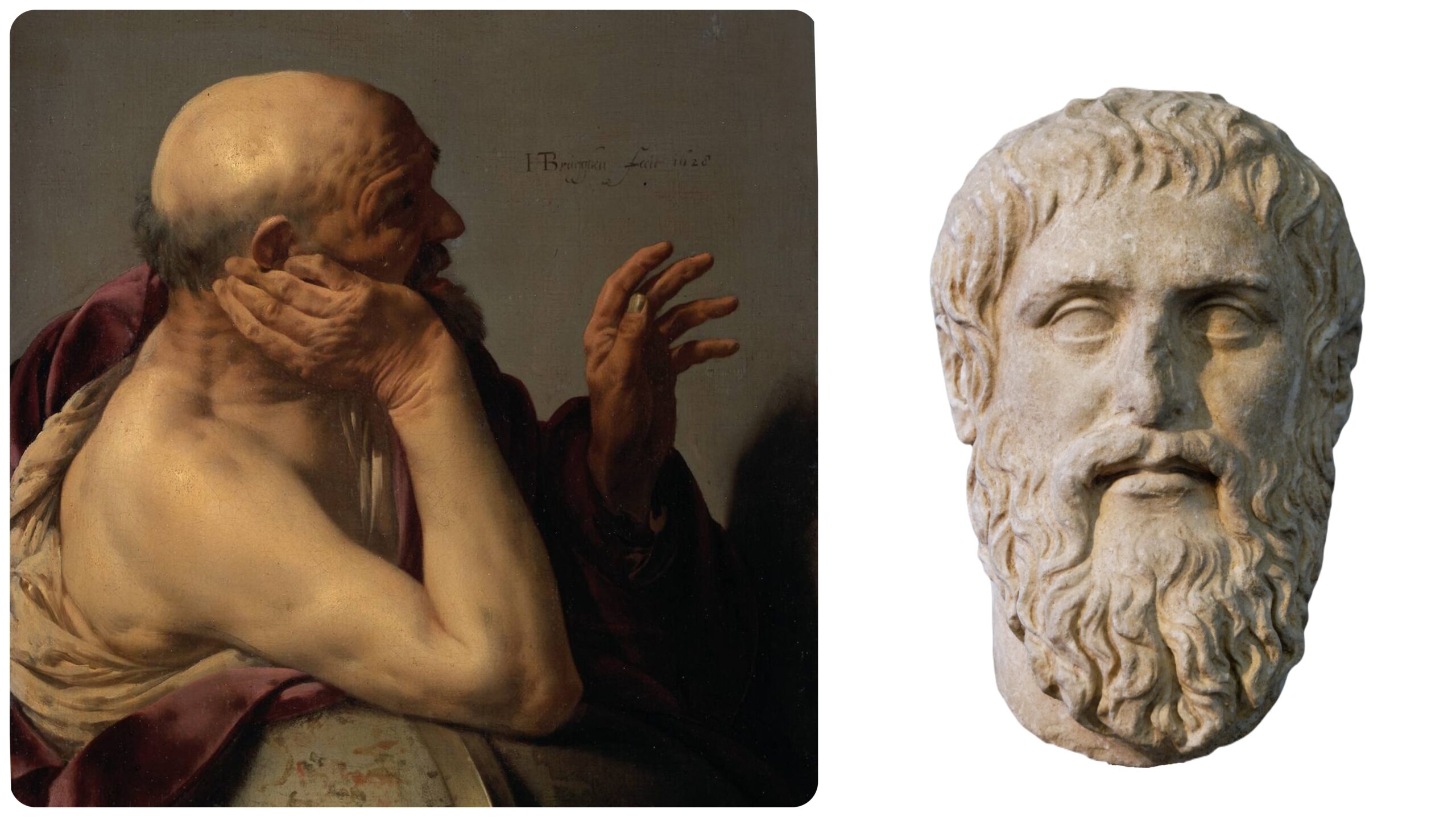
After Socrates, no philosopher shaped Western thought more profoundly than Plato. Born in Athens around 428/427 BCE, Plato was Socrates’ most famous student and later the teacher of Aristotle. His writings transformed philosophy into a systematic search for truth, justice, beauty, and reality itself. At the heart of his thought lies one of the most influential ideas in intellectual history: the Theory of Forms. 
The Theory of Forms: Reality Beyond the Material World
Plato argued that the world we see around us is not the highest reality. Everything in the physical world changes—people age, buildings crumble, flowers fade, and political systems rise and fall. Because the senses show us only changing things, Plato believed they cannot provide perfect knowledge.
Behind this visible world, he proposed, exists a higher and eternal realm of Forms (or Ideas): perfect, timeless, non-material realities such as Justice, Beauty, Equality, and Goodness. The objects we encounter in daily life are merely imperfect copies of these perfect Forms. A beautiful painting, for example, is only beautiful because it participates in the eternal Form of Beauty. 
This was Plato’s revolutionary answer to a timeless question: How can truth remain stable in a changing world?
The Cave Allegory: Plato’s Greatest Metaphor
Plato’s most famous explanation of this philosophy appears in The Republic through the Allegory of the Cave. He asks us to imagine prisoners chained inside a cave, able to see only shadows cast on a wall. Believing the shadows to be reality, they mistake appearances for truth.
When one prisoner escapes and sees the world outside, he discovers the sunlit reality behind the shadows. For Plato, this journey represents philosophy itself: moving from illusion to knowledge, from sensory appearances to rational understanding. 
This allegory remains one of the most powerful explanations of education, enlightenment, and critical thinking ever written.
Knowledge, Politics, and the Philosopher-King
Plato believed that only those trained to understand truth should govern society. This gave rise to his famous idea of the philosopher-king—a ruler guided not by ambition, wealth, or emotion, but by wisdom and reason.
His political philosophy continues to influence debates on leadership, ethics, governance, and education even in the modern age. 
Why Plato Still Matters Today
Plato’s thought remains deeply relevant in a world dominated by images, media, and misinformation. His philosophy encourages us to ask:
• Is what we see the whole truth?
• Are appearances deceiving us?
• What is justice in its purest sense?
• Can reason rise above opinion?
From modern law to political theory, education, theology, and metaphysics, Plato’s influence remains immense.
Final Takeaway
Plato taught humanity that truth is deeper than appearances. His Theory of Forms invites us to look beyond the visible world and search for the eternal principles that give life meaning.
In today’s fast-moving digital age, Plato’s timeless message still echoes: what seems real is not always what is true.