
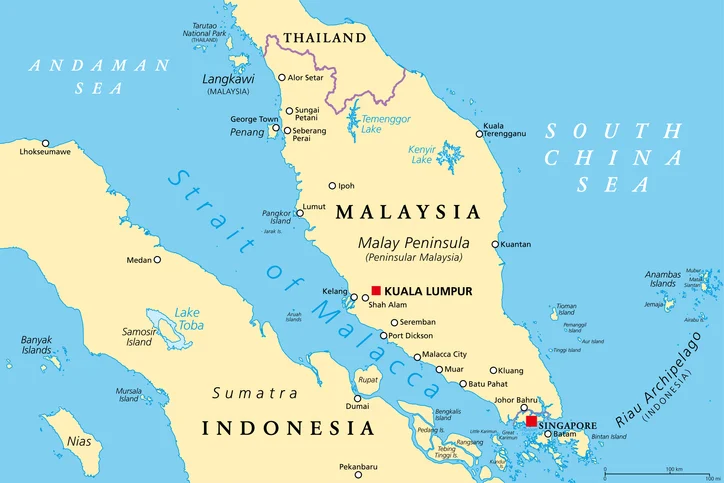
The Strait of Malacca is one of the busiest and most strategically important waterways in the world. Located between the Malay Peninsula and the Indonesian island of Sumatra, this narrow passage connects the Indian Ocean with the South China Sea and the Pacific Ocean. Stretching for nearly 800 kilometers, the strait serves as a critical maritime gateway for global trade and energy transportation.
Every year, tens of thousands of ships pass through the Strait of Malacca carrying goods, oil, natural gas, electronics, and raw materials between Asia, the Middle East, Europe, and Africa. Countries such as China, Japan, South Korea, and Singapore heavily depend on this route for imports and exports. Because of its strategic location, the strait is often considered one of the world’s most valuable shipping corridors.
One of the major reasons behind its importance is geography. The Strait of Malacca provides the shortest sea route between the Indian and Pacific Oceans. Without it, ships would need to travel through longer and more expensive routes around Indonesia’s islands, increasing both fuel costs and travel time. This makes the passage extremely valuable for international shipping companies and global economies.
The strait is also important from a geopolitical perspective. Several nations closely monitor activity in the region due to its economic and military significance. Singapore, Malaysia, and Indonesia cooperate to maintain security and navigation safety in the area. In the past, piracy was a major concern in the strait, but coordinated patrols and improved maritime surveillance have reduced such incidents significantly.
Another interesting feature of the Strait of Malacca is its narrowness. At its narrowest point near Singapore, the channel is only about 2.8 kilometers wide. This creates challenges for large vessels navigating through crowded waters, especially during poor weather conditions.
Today, the Strait of Malacca remains an essential artery of global commerce. Its role in connecting major economies ensures that it will continue to hold enormous strategic and economic importance in the future.