
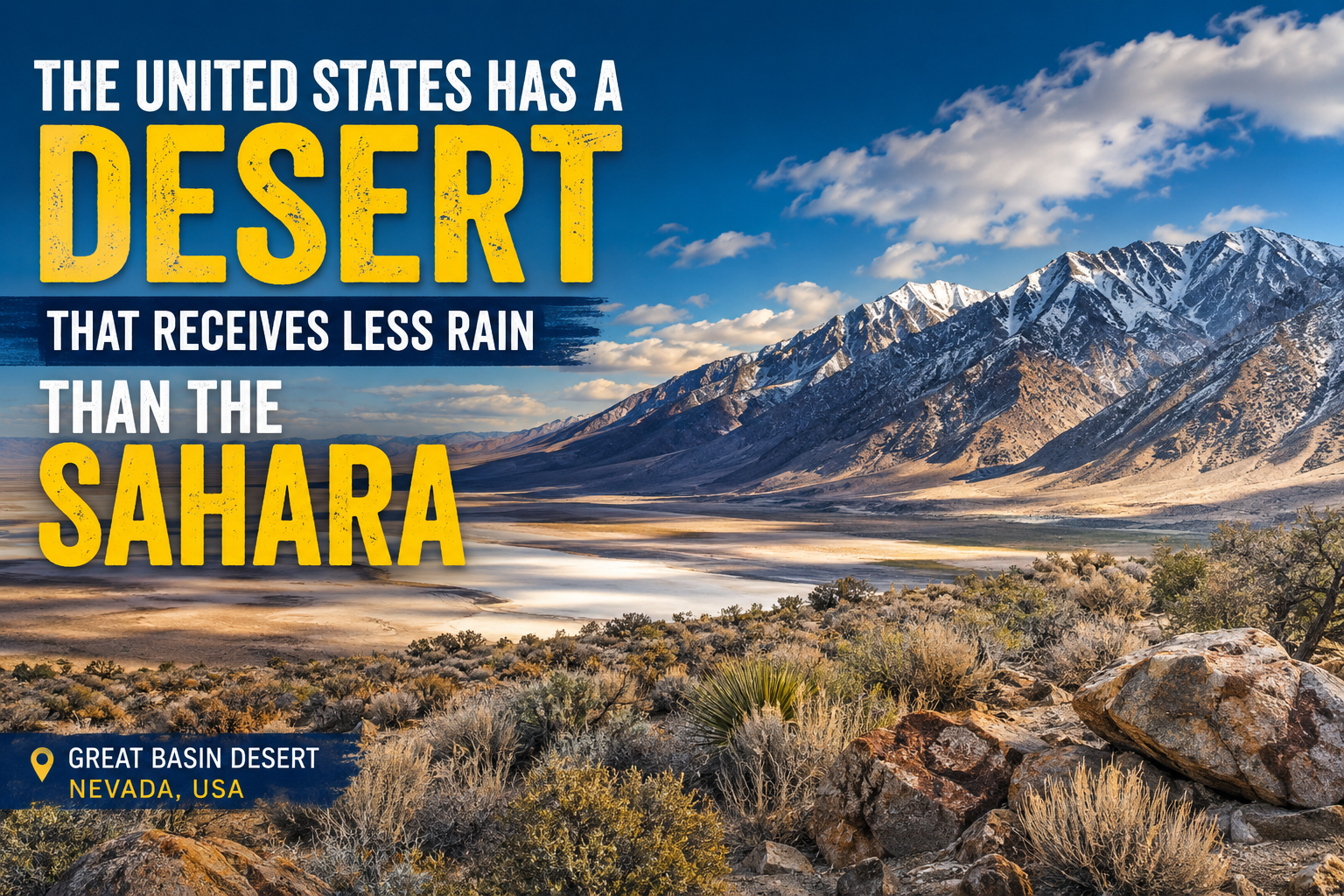
Many people imagine the United States as a country of forests, mountains, and fertile plains, but it is also home to one of the world’s most overlooked deserts. The Great Basin Desert, stretching across most of Nevada and parts of Utah, Oregon, Idaho, and California, is one of North America’s largest deserts. Surprisingly, parts of this desert receive less annual rainfall than some areas of the Sahara Desert, making it one of the driest places on the continent.
Unlike the hot deserts featured in Hollywood films, the Great Basin Desert is known as a cold desert. Winters often bring heavy snowfall, while summer temperatures can exceed 38°C (100°F). This dramatic seasonal contrast surprises many visitors who associate deserts only with scorching heat.
The reason for the desert’s extreme dryness lies in geography. The towering Sierra Nevada mountain range blocks moist air coming from the Pacific Ocean. As the air rises over the mountains, it releases most of its moisture on the western slopes. By the time it descends into the Great Basin, it has become warm and dry, creating what geographers call a rain shadow. This phenomenon leaves much of the region with less than 250 millimeters of rainfall each year.
Despite its harsh conditions, the Great Basin is rich in biodiversity. Plants such as sagebrush dominate the landscape, while wildlife includes pronghorn antelope, coyotes, jackrabbits, golden eagles, and wild horses. The desert also contains numerous mountain ranges, salt flats, and dry lake beds, making it one of the most geologically diverse regions in the United States.
Another surprising feature is that the Great Basin has no outlet to the ocean. Rivers and streams flowing within the region end in inland lakes, marshes, or simply evaporate. This unique drainage system gives the region its name and distinguishes it from nearly every other major landscape in North America.
Although often overshadowed by the Mojave and Sonoran Deserts, the Great Basin demonstrates that the geography of the United States is far more diverse than many people realize. Its unusual climate, isolated drainage system, and striking landscapes make it one of America’s most fascinating natural regions.