
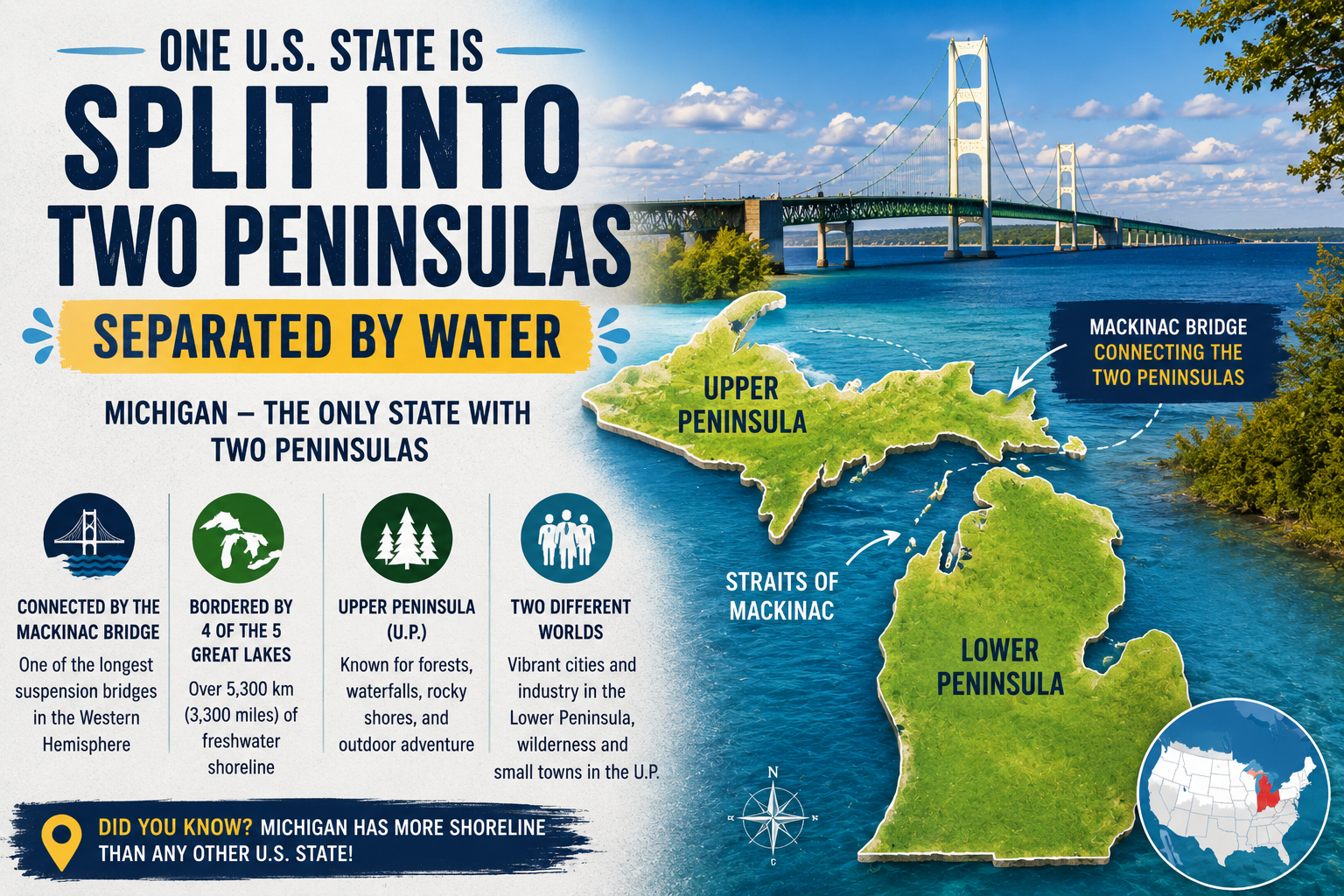
Many people assume that every U.S. state is a single continuous landmass, but Michigan breaks that expectation. It is the only state divided into two large peninsulas—the **Upper Peninsula (U.P.)** and the **Lower Peninsula**—which are separated by the Straits of Mackinac. Together, they create one of the most distinctive geographical layouts in the United States.
The Lower Peninsula is the part most Americans recognize. Shaped like a mitten, it is home to major cities such as Detroit, Grand Rapids, and the state capital, Lansing. The Upper Peninsula, by contrast, is much more rural, covered by dense forests, rocky shorelines, waterfalls, and rolling hills.
Connecting the two landmasses is the iconic Mackinac Bridge. Opened in 1957, the bridge spans approximately 8 kilometers (5 miles) across the Straits of Mackinac, making it one of the longest suspension bridges in the Western Hemisphere. Before the bridge was built, travelers relied on ferries to cross between the two peninsulas.
Another surprising fact is that Michigan is bordered by **four of the five Great Lakes**—Superior, Michigan, Huron, and Erie. No other U.S. state has more freshwater coastline. In fact, Michigan has over **5,300 kilometers (3,300 miles)** of Great Lakes shoreline, longer than the Atlantic coastline of the contiguous United States.
The Upper Peninsula is also known for its unique identity. Residents, often called “Yoopers,” have developed a distinct culture influenced by Native American heritage and immigrants from Finland, Sweden, and other northern European countries. The region receives some of the heaviest snowfall in the United States due to lake-effect snow generated by Lake Superior.
Despite being part of the same state, the two peninsulas differ significantly in population, economy, and landscape. While the Lower Peninsula is heavily urbanized and industrialized, the Upper Peninsula remains one of America’s least populated regions, attracting visitors seeking wilderness, hiking, fishing, and scenic beauty.
Michigan’s unusual geography makes it unlike any other state in the country. Its two-peninsula layout, extensive freshwater coastline, and striking natural diversity make it one of the most fascinating geographic features of the United States.