
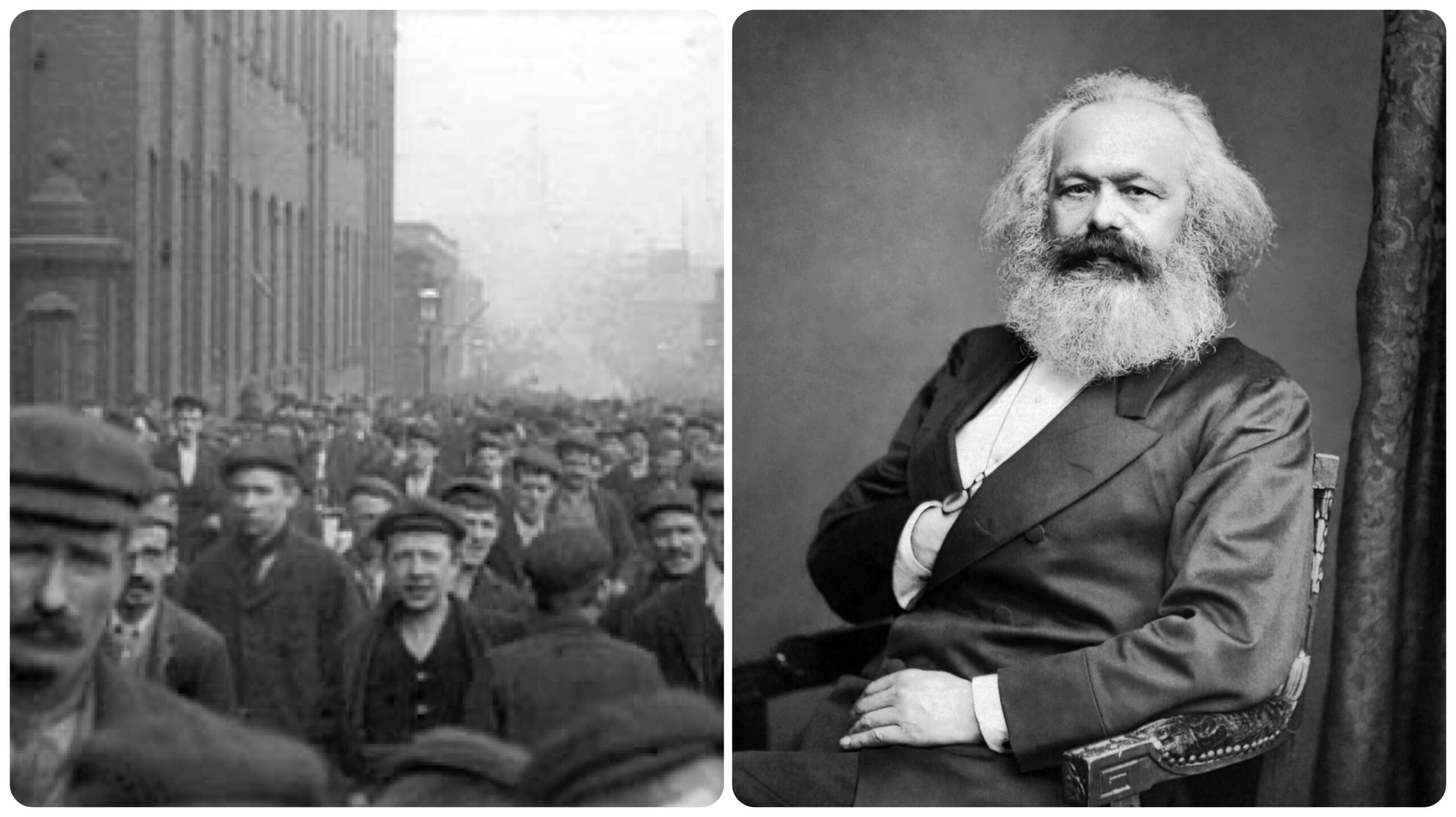
Philosophy of Karl Marx
Few philosophers have influenced modern politics, economics, and social movements as deeply as Karl Marx. Born in 1818 in Prussia, Marx developed a revolutionary analysis of society centered on class conflict, labor, and economic power. His ideas transformed the study of history and inspired political movements across the world. Whether praised or criticized, Marx remains one of the most influential thinkers in modern history.
Historical Materialism: Economics Shapes Society
At the foundation of Marx’s philosophy is historical materialism, the idea that economic conditions shape human society, politics, and culture. Marx argued that history is not driven mainly by ideas or great leaders, but by struggles over material resources and economic power.
According to Marx, every society develops through conflicts between social classes. In ancient societies this involved masters and slaves, while in feudal Europe it involved lords and peasants. In modern industrial society, the main conflict exists between:
* the bourgeoisie, who own factories, industries, and capital
* the proletariat, the working class who sell their labor for wages
For Marx, this conflict lies at the heart of capitalism.
Capitalism and Exploitation
Marx believed capitalism creates immense wealth but also deep inequality. Workers produce goods and services, yet much of the profit goes to the owners of capital. He called this process exploitation, arguing that labor creates value while workers receive only a fraction of what they produce.
He also warned that capitalism can lead to:
* economic inequality
* unstable financial crises
* alienation from work
* concentration of wealth in a small elite
Marx argued that workers often become disconnected from the products they create, from society, and even from their own humanity.
Alienation: The Human Cost of Industrial Society
One of Marx’s most important philosophical ideas is alienation. In industrial capitalism, workers may perform repetitive labor without creativity or personal fulfillment. As a result, work becomes mechanical rather than meaningful.
Marx believed this alienation damages human dignity because people lose control over their labor and their lives.
Revolution and Social Change
Marx predicted that growing inequality would eventually lead workers to unite against capitalist systems. He believed that class struggle would produce revolutionary social change and eventually create a classless society where resources are shared collectively.
His ideas later influenced socialist and communist movements around the world, especially during the twentieth century.
Why Marx Still Matters Today
Even in the modern digital economy, Marx’s ideas continue to shape debates about:
* wealth inequality
* workers’ rights
* corporate power
* automation and labor
* economic justice
Supporters see him as a critic of exploitation, while critics argue that Marxist political systems often produced authoritarian governments. Despite these debates, his analysis of capitalism remains highly influential in sociology, economics, and political theory.
Final Takeaway
Karl Marx taught that economic systems shape human lives and social structures. His philosophy challenged the world to examine inequality, labor, and power in a new way.
His message still resonates today: to understand society, follow the structure of wealth and work.
Philosophy of Karl Marx